Everyone wants to talk about yield. Bushels per acre. Calories per acre. How much food we can squeeze out of a piece of land.
That’s the metric driving modern agriculture—and it’s the backbone of arguments like the ones in We Are Eating the Earth.
But there’s a problem: not all calories are equal. And land doesn’t just produce calories. If you only measure output by weight or calories, you miss the one thing that actually matters: nutrition.
Calories Don’t Equal Nourishment
A field of corn can produce a massive number of calories per acre. So can soy. So can wheat. That’s why they dominate the global food system. But those calories are:
- heavily processed
- nutritionally incomplete
- often stripped of micronutrients by the time they’re eaten
They fill stomachs—but they don’t fully nourish bodies. Now compare that to land producing:
- pasture-raised meat
- eggs
- raw dairy
- diverse vegetables
- perennial fruits
You’re not just producing calories—you’re producing:
- complete proteins
- bioavailable minerals
- fat-soluble vitamins
- enzymes and cofactors
So the real question isn’t: “How many calories per acre?” It’s: “How much nourishment per acre?”
Nutrient Density Starts in the Soil
You can’t talk about nutrient density without talking about soil. Because plants don’t create minerals—they pull them from the ground. And soil isn’t just dirt. It’s a living system.
When soil is:
- biologically active
- rich in organic matter
- properly mineralized
Plants grown in that soil are:
- more nutrient-dense
- more resilient
- more complete as food
When soil is degraded:
- nutrients decline
- plants become weaker
- food becomes less nourishing
This isn’t theory—it’s been measured for decades. Modern crops, even when high-yielding, often contain fewer nutrients than they did historically.
So yes—you can increase yield., but you may be decreasing what that food actually delivers.
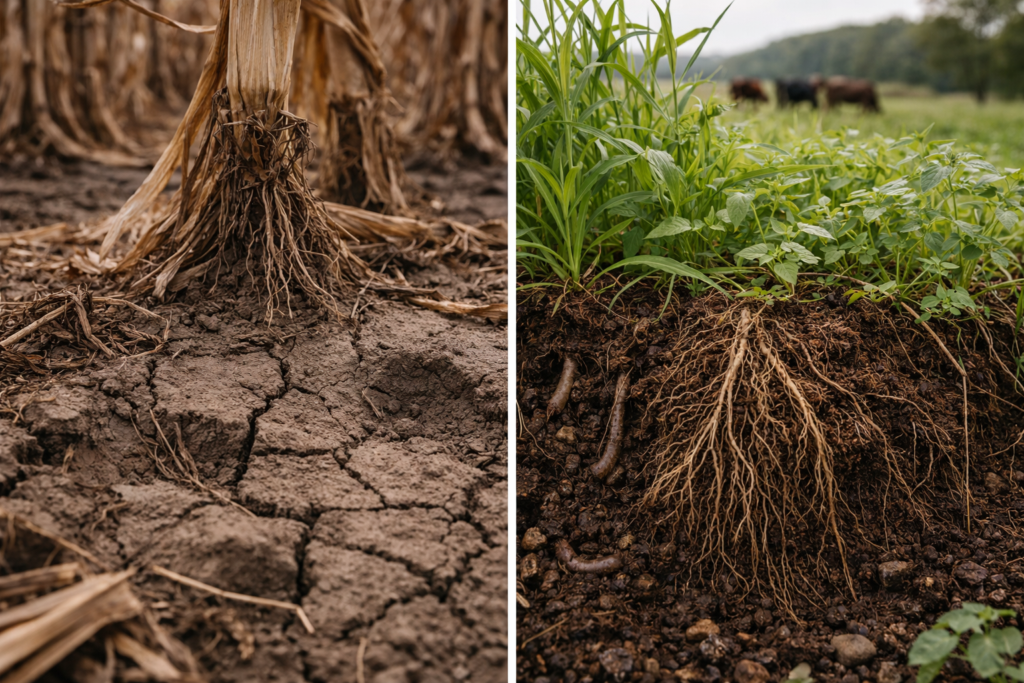
One Acre, Two Outcomes
Let’s compare two acres.
Acre A — Industrial Monocrop
- High-yield corn or soy
- Synthetic fertilizer
- Herbicide use
- Mechanized harvesting
Output:
- massive calorie production
- low nutrient diversity
- requires processing to become food
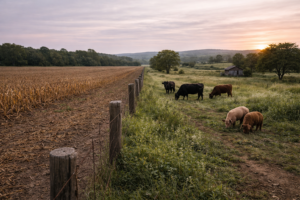
Acre B — Regenerative System
- Managed pasture with animals
- Diverse plant species
- Minimal external inputs
- Soil-building practices
Output:
- meat, fat, organs, milk
- complete amino acid profiles
- fat-soluble vitamins (A, D, E, K)
- improving soil and water retention
If you measure:
- calories → Acre A “wins”
If you measure:
- nourishment → Acre B dominates
The Illusion of “Feeding the World”
A lot of the push for high-yield agriculture is framed as: “We need to feed 10 billion people.” But here’s the uncomfortable truth: we are already producing enough calories globally.
The issue isn’t total calories—it’s:
- nutrient quality
- distribution
- food system structure
You can “feed” people with:
- refined grains
- processed oils
- sugar-heavy foods
And still end up with:
- nutrient deficiencies
- chronic disease
- metabolic dysfunction
That’s not a food shortage. That’s a nutrition crisis disguised as abundance.
Regenerative Land Produces More Than Food
This is where the conversation expands. A regenerative acre doesn’t just produce nutrients—it also:
- builds soil
- increases water infiltration
- supports biodiversity
- reduces erosion
- stabilizes the system over time
So when you compare acres, you’re not just comparing food. You’re comparing:
- a system that extracts vs
- a system that builds
And that matters long-term.
Why This Metric Changes Everything
If we shift the metric from: calories per acre to nutrients per acre, then suddenly:
- monocrops don’t look efficient
- regenerative systems don’t look “low yield”
- industrial agriculture loses its main argument
Because it was never producing the most nourishment—just the most volume.
The Real Question We Should Be Asking
Instead of “How much food can this land produce?,” we should be asking “How much life can this land support—above and below the ground?” Because that’s what determines:
- the quality of the food
- the health of the people eating it
- and the future of the land itself
Final Thought
We don’t have a calorie problem. We have a quality problem.
And until we start measuring food by what it actually gives the body—not just how much it weighs—we’re going to keep solving the wrong problem.