There’s a reason We Are Eating the Earth: The Race to Fix Our Food System and Save Our Climate is getting attention. It sounds rational. It sounds data-driven. It speaks in numbers, not emotion.
And on paper, it makes a strong case:
- We need more food
- We don’t have more land
- So we need to produce more on less
That leads to the conclusion: High-efficiency, industrial agriculture is the least harmful path forward.
But that entire argument rests on one assumption that doesn’t hold up on real land: That land is just a surface to optimize—not a living system. And that’s where everything breaks.
Land Is Not a Spreadsheet Variable
The book treats land like a fixed resource:
- X acres
- Y yield
- Z environmental cost
But land is not static. It’s not a container.
Land can:
- degrade
- stabilize
- regenerate
- or collapse
Industrial agriculture doesn’t just use land—it changes what that land is capable of becoming.
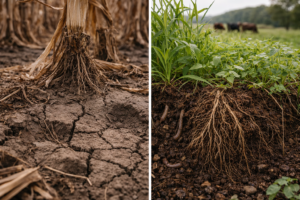
A monocrop field pushed for maximum yield is not neutral. It:
- reduces soil biology
- increases erosion
- weakens water retention
- requires more inputs over time
So when the book argues to “Use less land by maximizing yield,” it ignores the reality that high-yield systems often destroy the very function of the land they depend on.
Yield Per Acre Is the Wrong Metric
This is the core of the argument—and the core of the problem. The book prioritizes:
- calories per acre
- output per acre
But regenerative systems don’t measure success that way. Because land doesn’t produce just calories—it produces:
- fertility
- water cycling
- biodiversity
- animal health
- long-term productivity
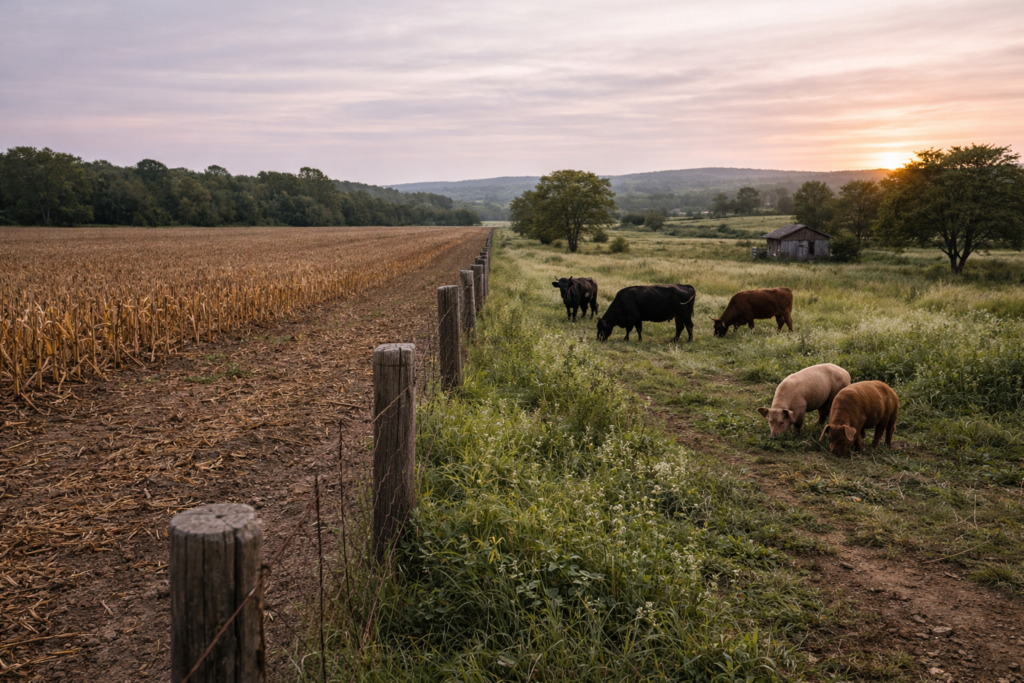
A regenerative pasture might produce:
- meat
- improved soil
- increased water infiltration
- carbon stability
- habitat
A monocrop field produces:
- one crop
- and a long list of external dependencies
Comparing those on “yield per acre” alone is like comparing:
- a diversified business to
- a single-product factory
It misses the whole picture.
There’s another problem with the “yield per acre” argument—and it’s a big one. It assumes all food is equal. It’s not. We broke that down here → The Missing Metric: Why Calories Per Acre Miss the Point
Efficiency Without Ecology Is a Dead End
The book leans hard on efficiency: more output, less land, fewer emissions But efficiency in a broken system doesn’t fix the system—it accelerates it.
Industrial agriculture is “efficient” because it:
- relies on synthetic nitrogen
- depends on fossil fuel inputs
- simplifies ecosystems into single crops
That’s not true efficiency. That’s input-driven productivity. And it comes at a cost:
- soil depletion
- water contamination
- fragile supply chains
- declining nutrient density
You can’t optimize your way out of a system that is fundamentally extractive.
Factory Farming Isn’t a Solution—It’s a Compression Strategy
One of the more controversial ideas in the book is that factory farming may be necessary to reduce land use. On paper, that works:
- confine animals
- feed them efficiently
- produce more with less land
But what’s actually happening is that they are compressing the problem, not solving it. Factory systems:
- disconnect animals from land
- require grain production elsewhere
- concentrate waste instead of cycling it
- rely on continuous inputs
In regenerative systems:
- animals build soil
- fertility cycles naturally
- land improves over time
So the question isn’t: “Which system uses less land today?” It’s “Which system leaves the land better after it’s used?”
Oil vs Corn Fuel Misses the Bigger Issue
The book leans toward practical energy realism—oil makes sense as a fuel, corn ethanol largely doesn’t.
And on that point, there’s alignment:
- Corn ethanol is inefficient
- It drives monocropping
- It’s policy-driven, not land-driven
But swapping corn for oil doesn’t solve the deeper issue.
Both are:
- external energy inputs
- disconnected from land health
- part of a system that requires constant extraction
Regenerative systems don’t ask:
“Which fuel is better?”
They ask:
“Why does this system require so much fuel in the first place?”
When you rebuild soil and ecology:
- you reduce inputs
- you reduce passes with machinery
- you reduce dependency
The goal isn’t just better fuel. It’s less need for fuel.
The False Choice Between Wilderness and Farming
Another underlying idea is that land should either be farmed or left alone. And the best outcome is:
- intensify farming
- spare the rest for nature
But regenerative agriculture challenges that binary because properly managed land can:
- function like a natural ecosystem
- support biodiversity
- restore degraded environments
You don’t have to choose between:
- feeding people
- and healing land
You can do both—if the system is designed correctly.
The Real Divide: Optimization vs Regeneration
At its core, this is a philosophical difference. The book is trying to:
- optimize a system
- minimize harm
- work within current structures
Regenerative agriculture is trying to:
- redesign the system
- restore function
- align with natural processes
One asks: “How do we make this less bad?” The other asks: “How do we make this work the way it’s supposed to?”
What This Looks Like in the Real World
On actual land—especially in places like Central Texas—you see it quickly. Degraded land:
- sheds water
- dries out faster
- requires more intervention
Regenerated land:
- holds water
- supports life
- becomes more productive over time
That doesn’t show up well in global models, but it’s the difference between:
- surviving
- and building something that lasts
Final Thought
The book isn’t wrong about the scale of the problem, but it’s solving for the wrong outcome. It treats land as something to minimize. Regenerative agriculture treats land as something to restore—and partner with. And once you see that difference, you can’t unsee it.